 AgronoBlog – Agriculture Blog
 Underneath the surface of your thriving banana plantation, a tiny yet relentless army is waging a silent war: nematodes. These microscopic, unsegmented worms are hidden root killers, compromising the plant’s foundation, its anchorage, and its ability to absorb water and nutrients. Despite their imperceptible size, the damage they cause can be catastrophic, leading to yield losses ranging from 20% to 100%, severely impacting the profitability and sustainability of banana and plantain plantations worldwide. If your plants show unexplained signs of stress, small bunches, or an alarming number of turnovers, it’s time to look underground. Understanding these microscopic enemies is the vital first step to protecting your investment and ensuring the longevity of your crop.
Know Your Attackers: The Most Damaging Nematode Species in Banana
Banana cultivation is a feast for various species of plant-parasitic nematodes, each with its own attack strategy. Identifying them is fundamental to implementing an effective defense plan.
The Fearsome Burrowing Nematode: Radopholus similis
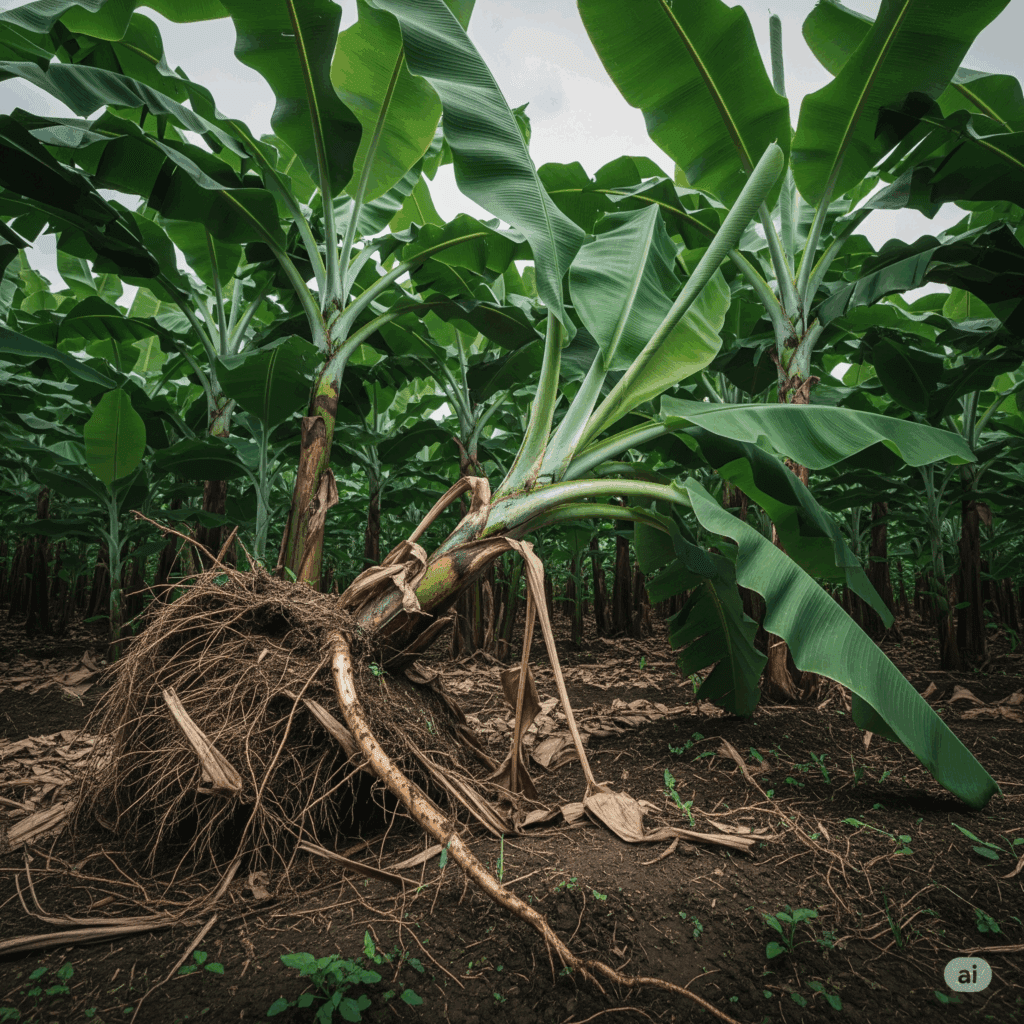
Considered the most destructive banana nematode globally, Radopholus similis is a migratory endoparasitic nematode. This means it not only penetrates the roots and corm (rhizome) but also actively moves within the plant’s tissues, feeding on its cells. As it moves, it leaves behind tunnels and cavities, creating extensive necrotic lesions that destroy vascular and cortical tissue. This destruction severely compromises water and nutrient absorption, and more critically, weakens the plant’s anchorage, making it extremely susceptible to toppling, especially during strong winds or when carrying a heavy bunch. It is one of the main causes of the “toppling disease” in many regions.

Other Underground Saboteurs: Pratylenchus, Helicotylenchus, and More
In addition to the burrowing nematode, other nematode species pose a significant threat:
- Lesion Nematodes (Pratylenchus coffeae): Similar to Radopholus, these are also migratory endoparasites that invade the root cortex, causing lesions that interfere with root function. They often coexist with Radopholus, exacerbating the damage.
- Spiral Nematodes (Helicotylenchus multicinctus, H. dihystera): These are ectoparasites or semi-ectoparasites. They feed on root cortical cells from the outside or partially penetrate. Although their lesions are not as deep as those of burrowing nematodes, high populations of these nematodes can cause considerable stress to the plant, contributing to overall root deterioration.
- Root-Knot Nematodes (Meloidogyne incognita, M. javanica): These are sedentary endoparasites that, once inside the root, establish themselves in a single location and alter cell growth, inducing the formation of swollen structures known as galls or knots. These galls divert nutrients and compromise the root’s absorption function. Although not as devastating in banana as in other crops, they can be a problem, especially in sandy soils.
- Reniform Nematode (Rotylenchulus reniformis): A semi-ectoparasite that can also cause damage by partially penetrating and feeding on roots.
The simultaneous presence of several nematode species (nematode complexes) is common and often results in cumulative and more severe damage to the plant.
The Warning Signs: How Root Damage Manifests Above Ground
Since nematodes operate underground, their primary symptoms are invisible. However, root damage inevitably reflects in the aerial part of the plant, manifesting as a gradual but persistent decline in its vigor and productivity. These symptoms are often confused with nutritional deficiencies or water stress, delaying diagnosis and treatment.

Direct Symptoms in Roots (Require Inspection)
Confirmation of the presence and type of nematodes requires root inspection:
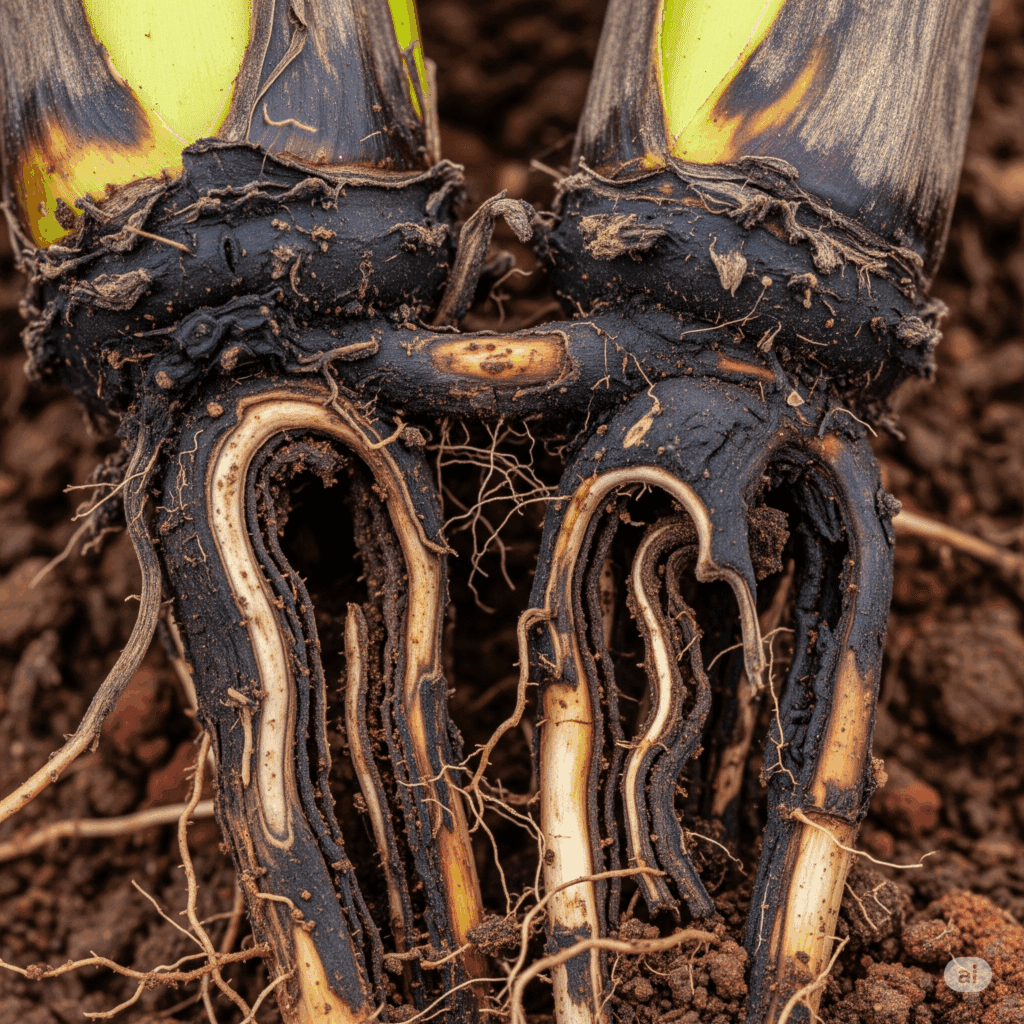
- Dark, Necrotic Lesions: Observe elongated dark brown to black spots on the cortex of the roots and the corm. These lesions are caused by Radopholus and Pratylenchus. As the damage progresses, the tissue rots and the roots break easily.
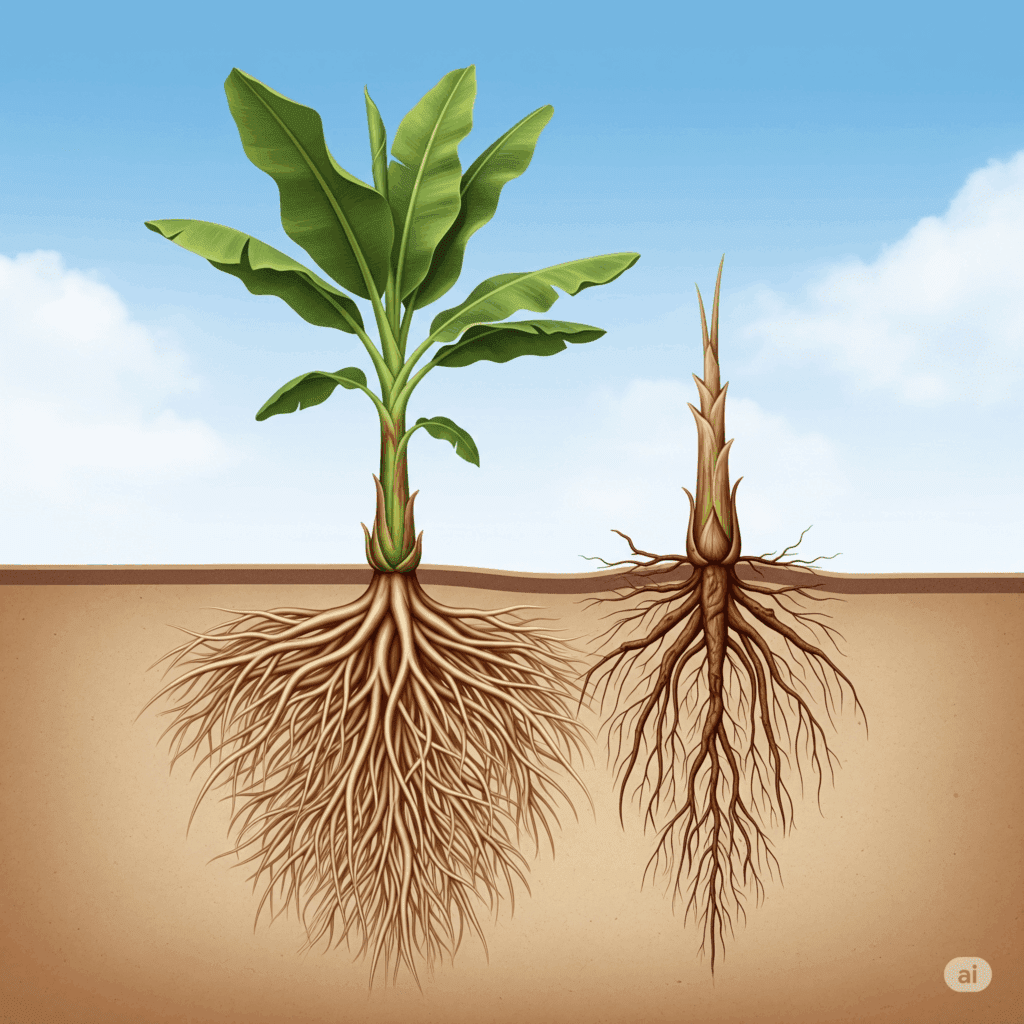
- Reduced Root Mass: The root system will be noticeably poor, with few fine roots and a “stale” or decomposed appearance.
- Galls and Knots: The presence of swellings or deformities on the roots is a clear sign of infestation by root-knot nematodes (Meloidogyne spp.).
- Generalized Rot: The roots become soft and watery, favoring the entry of secondary fungi that accelerate rot.
Indirect Symptoms in the Aerial Part (Symptoms of “Root Disease”)
When roots cannot function correctly, the plant suffers:
- Stunted Growth and Dwarfing: Infested plants grow more slowly, have thinner pseudostems, and are generally shorter. The leaves are smaller than normal.
- Yellowing and Foliar Chlorosis: Older leaves, and eventually younger ones, show generalized yellowing or paleness due to nutrient deficiency, as damaged roots cannot absorb them efficiently.
- Premature Leaf Drop: Older leaves dry out and die earlier than expected.
- Small Bunches and Underdeveloped Fruits: The lack of nutrients and water stress directly impact bunch development, resulting in smaller, lighter banana fingers and, consequently, a drastic reduction in commercial yield.
- Plant Toppling: This is the most devastating and visible symptom. Plants, unable to anchor firmly in the soil due to the rotten and weakened root system, easily fall over in wind, rain, or under the weight of their own bunch. This implies a total loss of the plant and its production.
- Reduced Plantation Lifespan: Affected plants enter a phase of productive decline much earlier than expected, shortening the profitable lifespan of the crop.
Defense Strategies: A Comprehensive Nematode Management Program
Effective control of banana nematodes is not achieved with a single measure, but through an Integrated Nematode Management (INM) program that combines various cultural, genetic, chemical, and biological practices. The key is to reduce nematode populations to levels that do not cause significant economic damage.
1. The Starting Point: Clean Planting Material
- Tissue Culture Plantlets (In Vitro): The smartest investment to start a plantation. These plantlets are produced in sterile environments and are guaranteed to be free of nematodes and other pathogens. It’s the only way to ensure a “clean slate.”
- Disinfection of Suckers/Corms: If using in vitro material isn’t possible, suckers or corms from healthy mother plants must be rigorously disinfected. This involves:
- Paring: Carefully removing the outer layers of the corm until healthy tissue is exposed, eliminating visible lesions and nematodes.
- Thermotherapy: Submerging pared corms in hot water at a controlled temperature of 52-55°C for 15-20 minutes. This kills most nematodes without damaging the corm.
- Nematicide Treatment: Complementing with a brief immersion in an approved nematicide solution, if necessary and permitted.
2. Soil Management and Agronomic Practices
- Fallowing and Crop Rotation: In soils with high nematode populations, leaving the land fallow for a period (at least 6 months to 1 year) can reduce populations by eliminating the host. Rotation with non-host crops for banana nematodes (such as corn, rice, sugarcane, or certain legumes) for one or two cycles can be very effective.
- Plantation Sanitation: Systematically remove and destroy old, diseased, or toppled banana plant residues (including roots and corms), as they are nematode reservoirs. Injecting plants with herbicide before removal helps kill nematodes inside them before they seek new hosts.
- Improved Drainage: Soils with poor drainage can stress banana roots and favor the spread of some nematodes. Good drainage improves root health and reduces the incidence of secondary diseases.
- Balanced Fertilization and Adequate Irrigation: Maintaining optimal nutrition and a constant water supply helps the plant develop a strong root system and better tolerate nematode damage. A vigorous plant is more resilient.

3. Chemical Control: Responsible Nematicide Application
- Monitoring and Decision: Nematicides should be used as part of a comprehensive program, not as the sole solution. Their application should be based on monitoring nematode populations through soil and root analysis.
- Rotation and Dosage: Alternate nematicides with different modes of action to prevent the development of resistance. Apply recommended doses at the appropriate time to maximize efficacy and minimize environmental impact.
- Application Technology: Ensure precise application in the plant’s root area.
4. Biological Control: Microscopic Allies
- Antagonistic Fungi and Bacteria: Research and the use of beneficial microorganisms are gaining ground. Fungi like Trichoderma spp. and Purpureocillium lilacinum (formerly Paecilomyces lilacinus) can parasitize nematode eggs and larvae or produce compounds that inhibit their growth. Some bacteria, such as Pasteuria penetrans, are obligate nematode parasites.
- Arbuscular Mycorrhizae: Inoculation with mycorrhizal fungi can improve nutrient absorption by roots and increase the plant’s tolerance to nematode-induced stress.
- Nematicidal Plants: Some plants (like Tagetes or Crotalaria) have nematicidal properties and can be used as cover crops or in rotation to reduce soil nematode populations.
5. Genetic Resistance: The Long-Term Solution
Research in genetic breeding focuses on identifying and developing varieties of banana and plantain that exhibit inherent resistance or tolerance to major nematode species, especially to Radopholus similis. Although it is a long process, it is the most sustainable and environmentally friendly long-term strategy.
The Future of the Fight Against Nematodes
The battle against banana nematodes is a long-distance race. The challenges include the development of resistance to nematicides, the difficulty of early detection, and the natural dispersal of these parasites. However, science is advancing, offering new hope:
- Molecular Detection: Development of faster and more sensitive detection methods to identify nematode species and quantify populations even before symptoms are visible.
- Biotecnología: Engineering of banana varieties with improved resistance to nematodes through genetic modification.
- Predictive Models: Use of artificial intelligence and climatic data to predict the appearance of nematodes and optimize management programs.
With a proactive approach, constant monitoring, and the implementation of an Integrated Nematode Management, banana producers can protect their root systems, ensure the stability of their plants, and maintain the productivity of their harvests against this invisible but formidable enemy.
References
- CABI. (n.d.). Radopholus similis (burrowing nematode). Retrieved from https://www.cabi.org/isc/datasheet/46487
- FAO. (n.d.). Integrated Pest Management in Banana. Retrieved from https://www.fao.org/fileadmin/templates/agphome/documents/PMP/Banana/PMP_Banana.pdf
- Plantix. (n.d.). Nematodes in plantain. Retrieved from https://plantix.net/es/library/plant-diseases/100085/banana-nematode/
- Promusa. (n.d.). Nematode management. Retrieved from https://www.promusa.org/Nematode%2Bmanagement
- Promusa. (n.d.). Radopholus similis. Retrieved from https://www.promusa.org/Radopholus+similis
- Universidad Nacional de Colombia. (2014). Manejo de nematodos en el cultivo de banano. [Research article].
- Universidad Técnica de Machala (Ecuador). (2018). Incidencia de nematodos fitoparásitos y su relación con el volcamiento de plantas de banano (Musa AAA cv. Cavendish). [Degree Thesis].