 AgronoBlog – Agriculture Blog
 In the world of banana cultivation, few threats instill as much fear as Fusarium Wilt, universally known as Panama Disease. This disease, caused by the soil-borne fungus Fusarium oxysporum f. sp. cubense (Foc), is a silent killer that attacks the heart of the plant, its vascular system, condemning it to a slow and inevitable death. What makes it so formidable is its survival capability: its resistance structures, chlamydospores, can remain viable in the soil for decades, even without the presence of a host. Its history has already marked a before and after in the global banana industry, and today, with the emergence of new and more virulent races, Panama Disease is once again jeopardizing the production of this vital fruit.
What is Panama Disease? Understanding the Enemy in the Soil
Panama Disease is a vascular disease affecting musaceae, including bananas and plantains. Its causal agent, Fusarium oxysporum f. sp. cubense (Foc), is a soil fungus classified into different races (also known as “special forms” or “vegetative compatibility groups” – VCGs), each with specificity for certain banana cultivars.
A Bit of History: The Threat of Foc Race 1 and the Transformation of the Industry
The history of Panama Disease is a lesson in the vulnerability of monocultures. In the early 20th century, Foc Race 1 devastated the vast plantations of the ‘Gros Michel’ (Musa AAA) variety in Latin America and the Caribbean, which was the predominant export banana at the time. The disease was so virulent that it forced the industry into a radical and costly change: the almost complete replacement of ‘Gros Michel’ with the ‘Cavendish’ variety (Musa AAA), which was resistant to Race 1. This transition redefined the taste and texture of the banana we consume today and is a testament to the destructive power of this pathogen.

The New Threat: Tropical Race 4 (TR4) Fusarium
The 21st century brought a new nightmare: Tropical Race 4 (TR4) of Foc, also known as Fusarium odoratissimum in some recent taxonomic classifications. This race is particularly alarming because, unlike previous ones, it is capable of infecting and destroying ‘Cavendish’ plantations, the variety that currently dominates the global banana trade (accounting for around 50% of global production). Since its appearance in Southeast Asia in the 90s, TR4 has spread to Africa and, more recently, to Latin America, generating an unprecedented global phytosanitary alert. Its potential impact on food security and the economy of producing countries is immense.
How Does Fusarium Attack? The Infection Cycle and its Symptoms
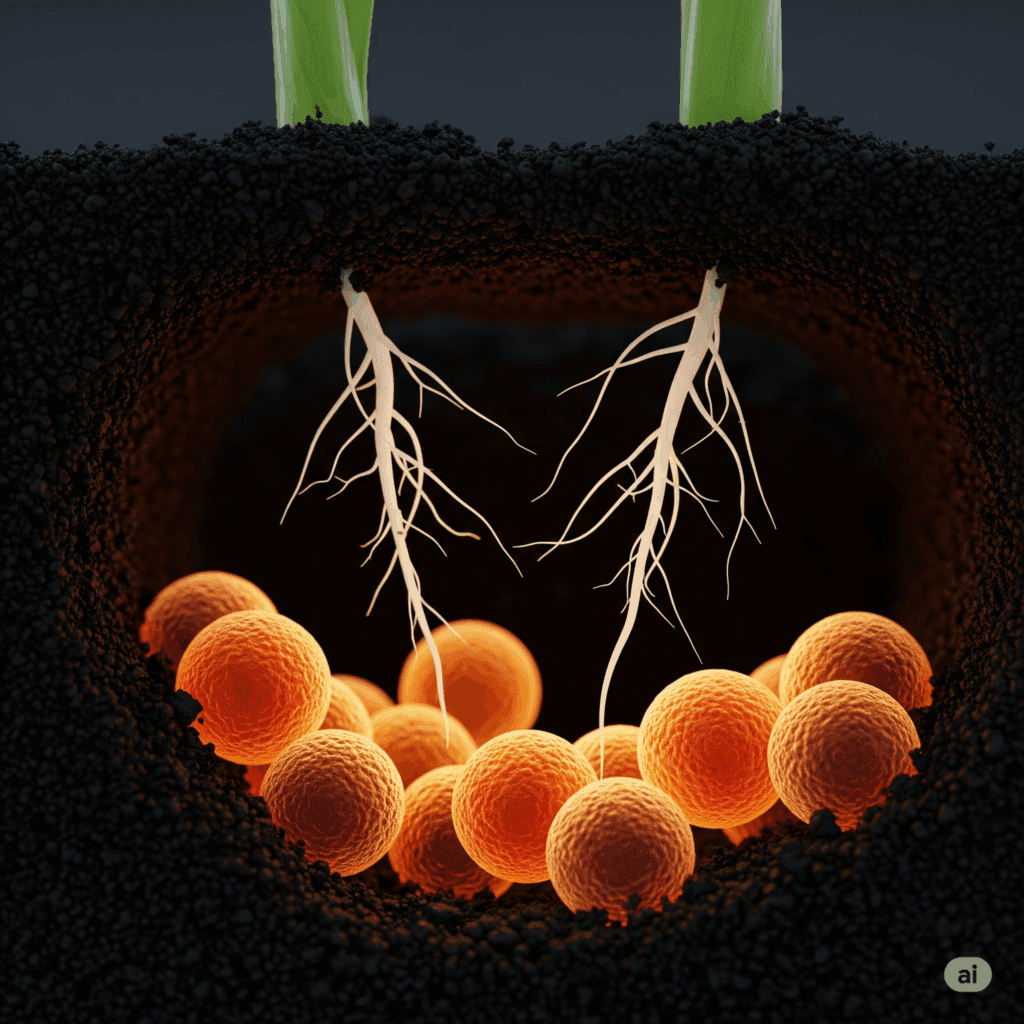
Foc is a soil-borne fungus. Its chlamydospores (thick-walled resistance structures) can survive in the soil for over 30 years in the absence of a host. When the roots of a susceptible banana plant grow nearby, root exudates stimulate the germination of these chlamydospores.
The fungus penetrates the plant through small wounds or vulnerable points in the roots and colonizes the xylem (the vessels that transport water and nutrients from the roots to the leaves). Once inside, the fungus multiplies and produces toxins, obstructing and destroying the vascular tissues. This obstruction prevents the flow of water and nutrients, leading to wilting and death of the plant.
Recognizing the Symptoms of Fusarium Wilt in Plantain
The symptoms of Panama Disease are characteristic and progressive:
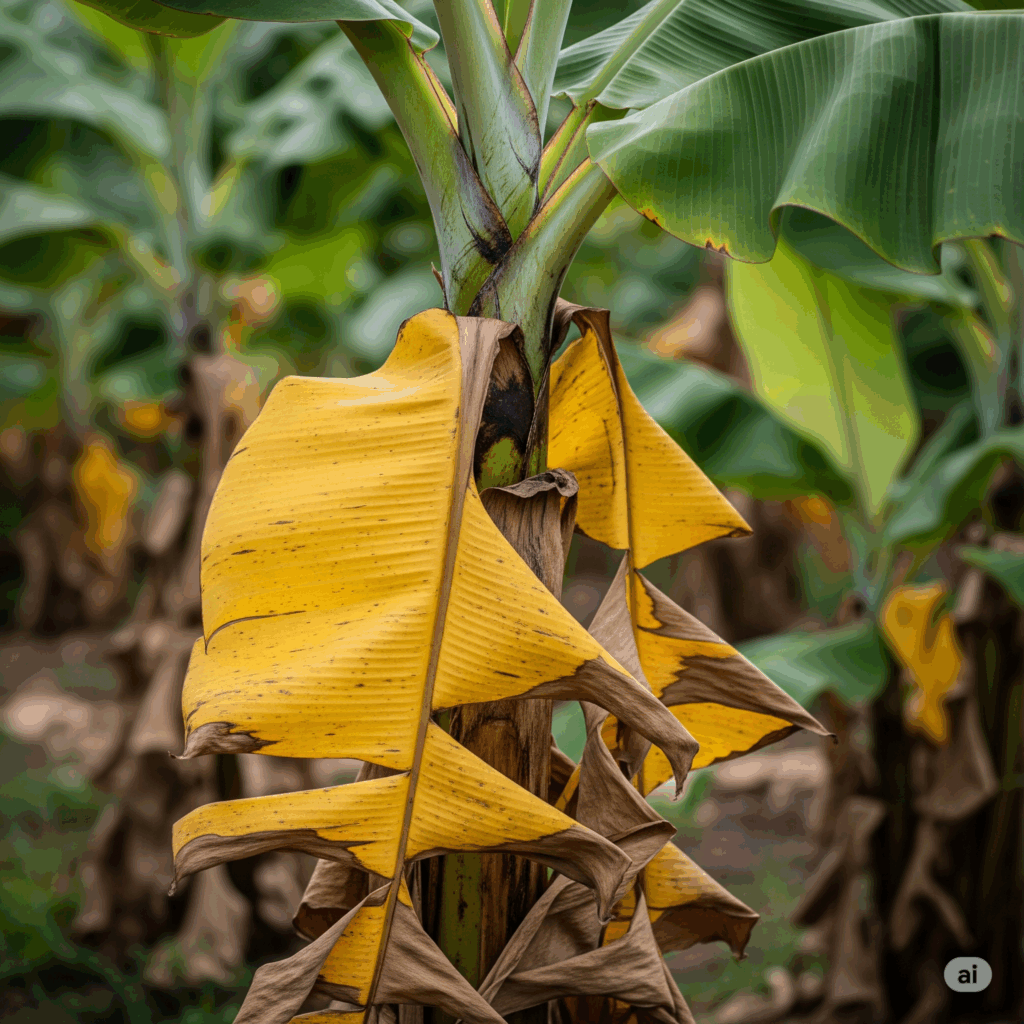
- Leaf Yellowing and Wilting: The first signs are usually the yellowing of older leaves, starting at the edges and progressing towards the central vein. This yellowing can be unilateral, meaning it affects only one side of the leaf or plant.
- Leaf Collapse: Affected leaves wilt, bend at the petiole (leaf stalk), and hang around the pseudostem, forming a “skirt” or “faldon” of dry leaves. In advanced stages, all leaves except the youngest may collapse.
- Pseudostem Cracking: In some cases, especially in susceptible varieties or with severe infections, longitudinal cracks may appear at the base of the pseudostem.
- Internal Vascular Discoloration: This is the most important diagnostic symptom. When a cross-section of the rhizome (corm) or pseudostem of an infected plant is made, a reddish, brown, or black discoloration is observed in the vascular bundles, contrasting with the healthy cream-colored tissue. This discoloration is evidence of xylem obstruction by the fungus.
- Stunted Growth and Plant Death: Infected plants show stunted growth and severely compromised fruit production, or no production at all. Eventually, the plant completely wilts and dies. Offshoots emerging from a diseased plant are also usually infected and will show similar symptoms.

It is crucial to differentiate Panama Disease from other diseases such as Moko (which also causes wilting, but with a bacterial exudate and male flower rot) or Black Sigatoka (which predominantly affects leaves with necrotic spots).
Panama Disease Management Strategies: Prevention and Biosecurity are Key
Once Foc is established in the soil, it is practically impossible to eradicate. There are no effective chemical fungicides to cure infected plants or to sustainably eliminate the fungus from the soil. Therefore, the control of Panama Disease is fundamentally based on prevention, strict biosecurity, and the use of resistant genetic material.
Pillars of Integrated Fusarium Wilt Management

- Rigorous Biosecurity: This is the most critical measure, especially to prevent the entry of Tropical Race 4 (TR4) into free areas or to contain its spread in already affected areas.
- Certified Planting Material: Use only plantlets from tissue culture (in vitro), certified as pathogen-free. Never use plant material (offshoots or corms) from plantations with a history of the disease.
- Movement Control: Restrict the movement of people, vehicles, machinery, and tools between farms, and within the same farm. Implement mandatory disinfection protocols for footwear, tools, and vehicles when entering and leaving cultivation areas. Quaternary ammonium or 10% sodium hypochlorite solutions are effective.
- Delimitation and Quarantine: If a focus of infection is detected, the area must be immediately delimited and quarantined. Banana or plantain should not be planted in that area for at least 18 months, although the fungus can persist much longer.
- Water Management: Avoid surface water runoff between affected and healthy areas, as water can transport spores.
- Eradication of Infected Plants: When a plant with Panama Disease symptoms is detected, it must be eradicated immediately.
- Herbicide Injection: It is recommended to inject a systemic herbicide (such as 20% glyphosate) into the pseudostem to ensure rapid plant death and prevent the production of new spores. Once the plant has died, it can be covered with plastic to solarize the soil and reduce the viability of the chlamydospores.
- Removal of Surrounding Plants: It is suggested to also remove asymptomatic plants within a radius of at least 5 to 10 meters around the diseased plant, as they could be infected without showing symptoms.
- Soil Management and Cultural Practices:
- Improved Drainage: Soils with poor drainage and waterlogging favor the development of the fungus. Good drainage reduces the spread and establishment of the pathogen.
- Crop Rotation: In infested soils, rotation with non-host crops (such as rice, sugarcane, pineapple, or certain grasses) can help reduce the pathogen’s inoculum load over time.
- Nutrient Management: Balanced plant nutrition makes the plant more robust, although it does not make it resistant to Foc.
- Use of Cover Crops: Some living cover crops can reduce soil and water splash, decreasing pathogen dispersion.
- Genetic Resistance: The Long-Term Hope The most sustainable and long-term strategy to combat Panama Disease is the development and use of banana varieties resistant or tolerant to Foc, especially Tropical Race 4. Great research efforts are being made worldwide to identify and create new cultivars through conventional genetic breeding and biotechnology (genetic engineering). Some wild varieties and hybrids already show a certain level of resistance. This approach is crucial to ensure the future viability of the banana industry.
- Biological Control: Although still in the research and large-scale development phase, the use of biological control agents such as certain strains of Trichoderma spp. and Bacillus subtilis has shown potential to suppress Foc growth in the soil and promote root health. These microorganisms can compete with the pathogen for nutrients or produce antifungal compounds.
Panama Disease is a persistent and serious threat. International collaboration, continuous research in genetic resistance, and strict adoption of biosecurity measures are the pillars to protect banana cultivation from this devastating subterranean enemy. Constant vigilance and rapid action are your best defense.
References
- CABI. (n.d.). Fusarium oxysporum f. sp. cubense (Panama disease of banana). Retrieved from https://www.cabi.org/isc/datasheet/24434
- FAO. (2019). Banana Fusarium Wilt – Tropical Race 4 (TR4). Retrieved from https://www.fao.org/plant-protection/resources/fao-technical-guidance-resources/banana-fusarium-wilt-disease-tr4/es/
- Government of Mexico – SENASICA. (n.d.). Panama Disease – Fusarium oxysporum f. sp. cubense (Foc). Retrieved from https://www.gob.mx/senasica/documentos/mal-de-panama-105161
- Promusa. (n.d.). Fusarium oxysporum f. sp. cubense. Retrieved from https://www.promusa.org/Fusarium%20oxysporum%20f.%20sp.%20cubense
- SENASICA. (n.d.). Technical Sheet Fusarium oxysporum f. sp. cubense Tropical Race 4. Retrieved from https://dj.senasica.gob.mx/Contenido/docs/vgtl/foc_r4t/5_Ficha%20T%C3%A9cnica%20FOC%20R4T%20Actualizaci%C3%B3n%20Abril%202021.pdf
- University of Costa Rica. (n.d.). Panama Disease in Banana (Fusarium oxysporum sp. cubense). Retrieved from https://www.ingbiosistemas.ucr.ac.cr/wp-content/uploads/documentos/BoletinFusarium.pdf
- ZeriMar Laboratoire. (n.d.). Fusarium oxysporum f. sp. cubense in Plantain. Retrieved from https://www.zerimarlaboratoire.com/guia-enfermedades-plantas/fusarium-oxysporum-f.-sp.-cubense-en-platanera